In Austria, over 100 of the country’s largest companies have undergone a detailed digital accessibility audit, with more than 90% of them failing to some extent. Sometimes failure is spectacular; often, it is inconspicuous in nature. Noticeably, users are unable to carry out important tasks such as filling out forms and clicking on relevant buttons. If screen readers fail or partly function, this too is a failure. However, the reasons for such failures are not obvious. This is revealed by the recent study of digital accessibility of over 100 top Austrian companies. The results of the study are public and affect all boards in Europe.
The study on digital accessibility in Austria’s companies is not a matter for Austria alone. Above and beyond the specific results of the study, the findings are a wake-up call for companies across Europe. The Digital Accessibility Law in Austria sets strict requirements for private sector companies based on the WCAG 2.1 AA standards. The study reveals a huge gap between intent and action. However, the study also offers many valuable lessons for companies who want to stay ahead of the curve and use accessibility as a business opportunity rather than a necessity at the last minute.
Table of Contents
What is Austria’s Digital Accessibility Law?
The Austrian Parliament enacted the Accessibility Act, locally known as the Barrierefreiheitsgesetz (BaFG), in 2023. Austria’s Digital Accessibility Law, or Barrier-Free Information Technology Act (BITAG), is based on the EU Web Accessibility Directive (2016/2102) and, unlike in most other countries, also includes large numbers of private sector companies from all industries that provide essential services (e.g., banks, online retailers, telecommunications providers, and travel companies).
Austria’s Digital Accessibility Legislation requires websites, mobile applications, and other digital interfaces to be perceivable, operable, usable, and robust for people with disabilities. It is enforced by administrative fines and civil action. The legislation matches the internationally recognized Web Content Accessibility Guidelines (WCAG) 2.1 Levels A and AA, providing a solid and quantifiable benchmark.
About the Accessibility Study
Accessibility Study about the Accessibility of the Private Sector in Austria.
The Accessibility Study was conducted by a consortium of digital compliance experts and accessibility advocates:More than 100 of the largest companies from the private sector of Austria: banks, telecommunication companies, energy suppliers, and retail companies, as well as companies from the transport and logistics sector.
The study uses the minimum legal requirements for most offers and services on the internet (WCAG 2.1) on Level A and AA.
A combination of automated crawling tools to detect technical barriers of access and a manual evaluation by the experts in order to identify contextual and usability-related barriers of access, which software alone is not able to identify.
Key Findings from Austria’s Largest Companies
The results are mixed, with some industries performing much better than others.
However, the overall performance of the companies tested amounted to approximately 55 to 65% of the necessary requirements of the WCAG 2.1 AA guidelines. There is a high level of awareness with respect to the law, but the implementation is fragmented.
The banking and financial services sector is clearly leading here with an average accessibility level of around 80%. This is due in large part to intense scrutiny by authorities as well as a firm business interest to win customer trust. Thus, the largest companies in this sector have invested a lot of time and money in order to create a satisfactory and accessible online experience for their customers.
Key differences between industries: Retail and e-commerce are the worst performers. They scored only about 50% compliance, due to reasons such as high content turnover, usage of third-party plugins, and a strong focus on design over usability.
Most Common Accessibility Issues:
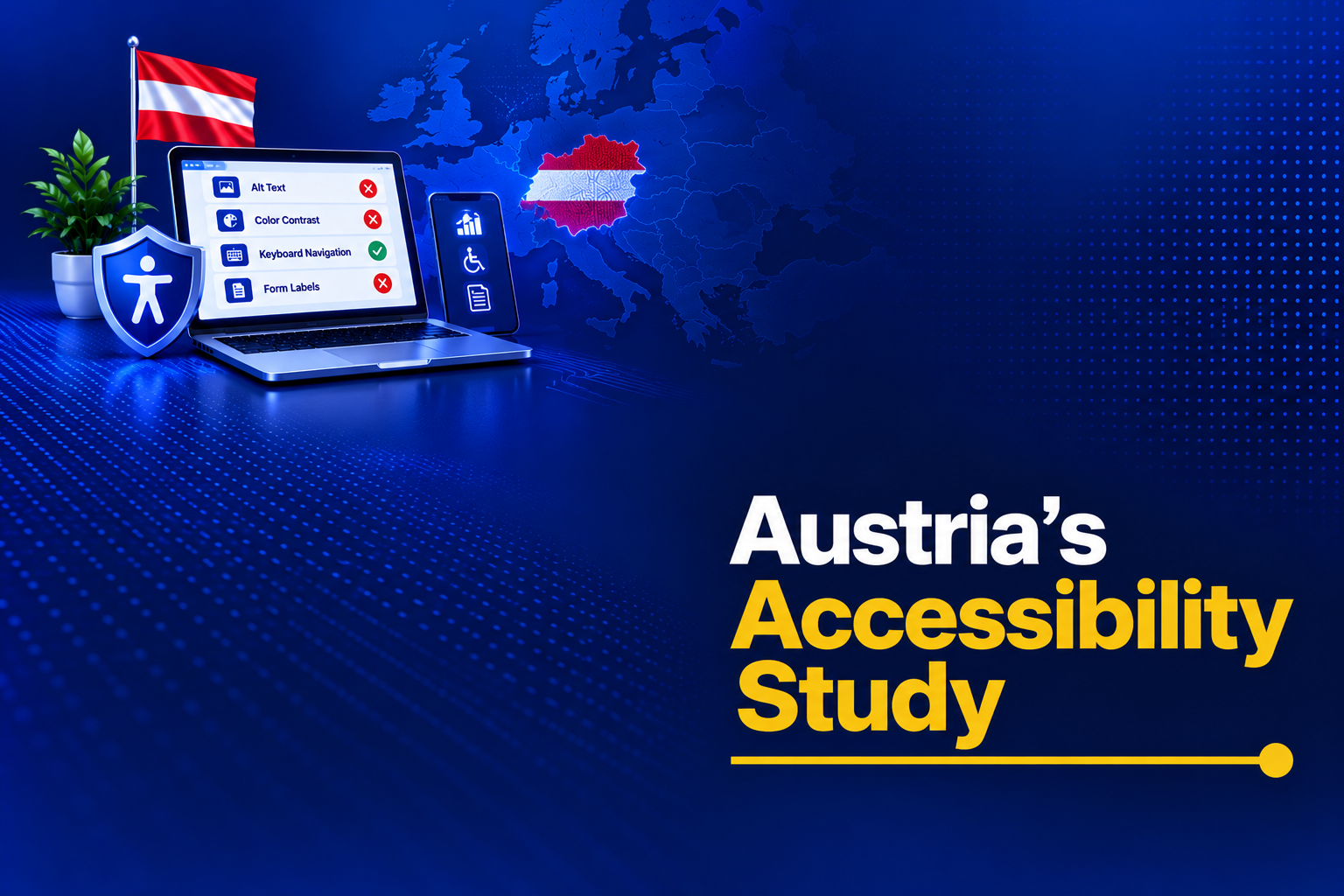
Austria’s accessibility study found that many websites still struggle with some of the most basic accessibility requirements. Here are some of the common accessibility problems identified in the study and why they matter.
Lacking alternative text (alt text) for images and icons, which means that users who use a screen reader cannot fathom that there are images and icons on a certain website.
Insufficient Color Contrast – Text that sits on top of a background and fails to meet minimum contrast ratio, making text very hard to read for people with vision loss.
Links that are not Navigable with a Keyboard – Some sites use images or irregularly sized links to help navigation. These can trap users with motor disabilities who use keyboards to navigate.
Unlabeled Form Fields – Many form fields were found to not have been correctly labeled. Therefore, screen readers and other assistive technology tools are unable to provide instructions to users when completing these online forms.
Improper structure and semantic markup of content, which dissuades screen readers and other assistive technologies from correctly interpreting and navigating a webpage.
What Businesses Can Learn?
The study’s findings underscore a fundamental truth: good intentions are not enough; technical precision is required. For Austrian businesses and organizations globally, the lesson is clear:reactive, piecemeal fixes will not suffice. You need a systematic, expert-driven approach.
This is where AEL Data transforms challenges into actionable solutions.
1. Automated Scanning with the AAC Checker
The first step is understanding your current digital health. AEL Data’s AAC (Accessibility Analysis Checker) rapidly crawls your entire digital ecosystem—websites, apps, and documents—to flag technical violations against WCAG standards. It identifies low-hanging fruit like color contrast issues and missing alt text, providing a high-level “health check” in record time.
2. Expert-Led Manual Audits
Automated tools catch only 30 to 40% of accessibility barriers. They cannot determine if a navigation flow is logical or if a screen reader interprets content in the correct order. AEL Data’s certified accessibility experts (CPACC and WAS certified) conduct comprehensive manual audits, using real assistive technologies like JAWS, NVDA, and VoiceOver to uncover the contextual and usability issues that algorithms miss.
3. Strategic Web Accessibility Consulting
Accessibility is not a one-time project; it is a continuous process. AEL Data partners with your design and development teams to embed accessibility into Agile workflows, create robust accessibility statements, and deliver ongoing training. We don’t just tell you what is broken; we show you how to build it right from the start.
Why Accessibility is More Than Compliance
Viewing accessibility solely through the lens of penalty avoidance leaves massive value on the table. The Austrian study is a business case, not just a legal warning. Here are three reasons accessibility should be part of your digital strategy:
1. Unlocking the “Purple Pound” – Over 15% of the global population lives with some form of disability. In Austria, this represents a multi-billion-euro market segment. By excluding these users, companies are alienating a significant customer base.
2. SEO and UX Synergy – The technical fixes required for accessibility, clear headings, descriptive links, and semantic HTML, are the same pillars Google uses to rank websites. Improving accessibility boosts search visibility and usability for all visitors.
3. Brand Reputation and ESG – Environmental, Social, and Governance (ESG) criteria are increasingly important to investors. Proactive digital inclusion signals ethical leadership and social equity, attracting top talent and loyal customers.
Making your website accessible helps you reach more customers, improve the experience for everyone who visits your site, and build a brand that values inclusion. It shows why accessibility makes good business sense.
Conclusion: Austria’s Wake-Up Call for the Global Market
Austria’s accessibility study is more than a national report card. It is a crystal ball for what is coming to the rest of Europe and the world. As regulations tighten and enforcement ramps up, companies that invest in accessibility today will be the market leaders of tomorrow. The findings show that while the journey is complex, the roadmap is clear: rigorous testing, expert oversight, and a commitment to continuous improvement.
Whether your business operates in Austria or anywhere else in Europe, accessibility is no longer something to leave until the last minute. It is an opportunity to create better websites, serve more customers, improve usability, and stay aligned with evolving regulations. The sooner accessibility becomes part of your design and development process, the easier it is to build digital experiences that work for everyone.
Do not wait for a penalty or a lawsuit to force your hand. Partner with a team that understands the letter of the law and the spirit of inclusion.