The Web Content Accessibility Guidelines (WCAG) have been the guidelines to follow to make web content accessible for decades. As the European Accessibility Act (EAA) is now in force and is being used to take court action against individual businesses who fail to meet the requirements of the legislation to make their web content accessible. Just passing a test (automated or otherwise) isn’t enough to determine conformance to the requirements of WCAG 2.1 via EN 301 549.
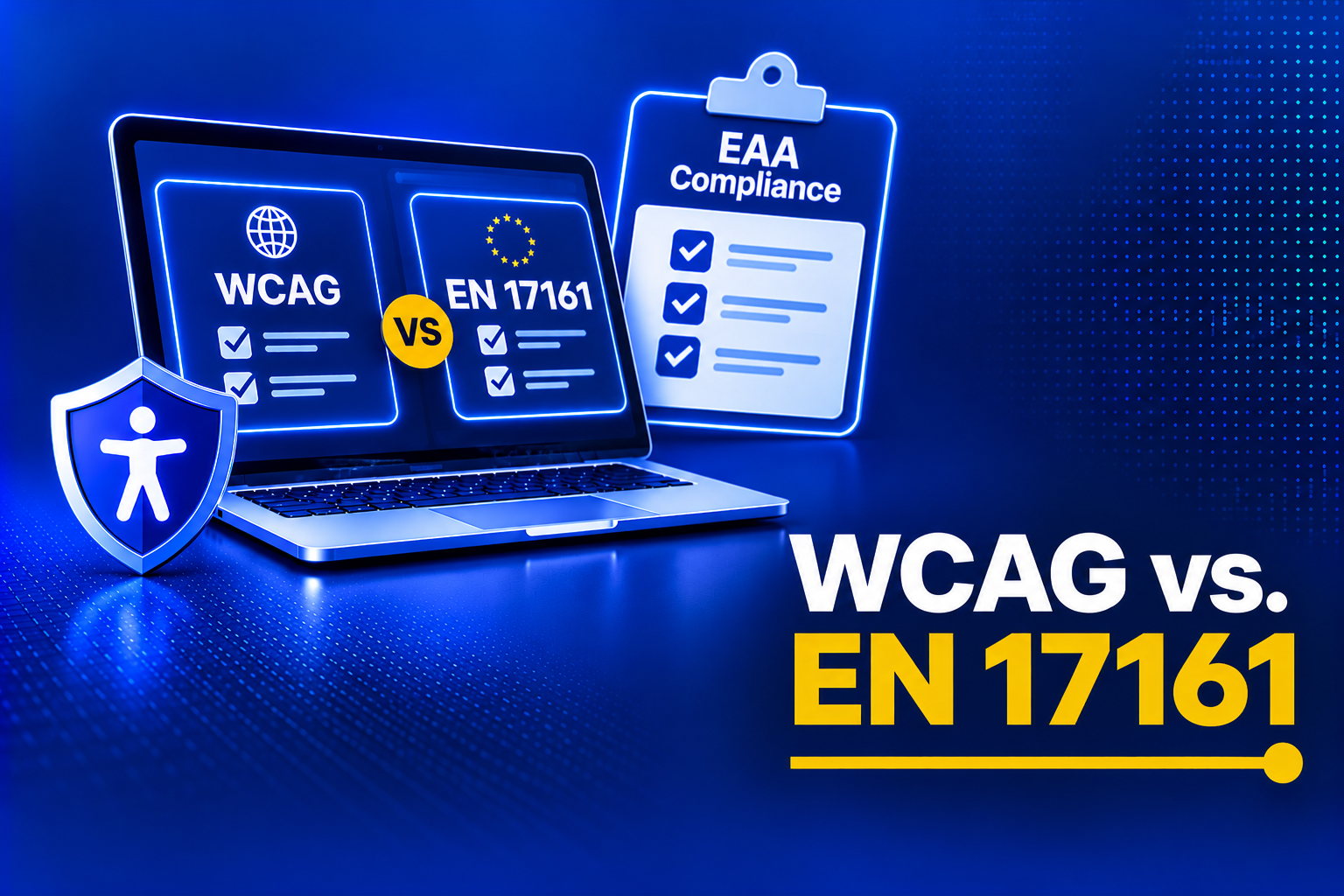
Unfortunately, meeting the requirements of the EAA needs a completely different approach than just passing a test to check for conformance to WCAG 2.1. Accessibility needs to be operationalized just like privacy or security. Therefore, WCAG needs a parallel standard for the future: EN 17161. In this blog, we will explore the differences between WCAG & EN 17161 to help you understand the best way forward.
Table of Contents
What is WCAG?
The Web Content Accessibility Guidelines (WCAG) are a set of global standards for accessibility of web content published by the W3C. Unlike the management of behavior of organizations, these standards measure the technical quality of web content (websites, mobile applications) that people with disabilities and people who use assistive technology also can make use.
The four accessibility guidelines that the Web Content Accessibility Guidelines (WCAG) are based upon are Perceivable, Operable, Understandable, and Robust (POUR).
WCAG has three levels: A, AA, and AAA. But it’s not a ladder where you move from A to AA to AAA. Issues can happen at any level. If your site stops meeting the criteria, you simply don’t conform at that level. These are used by accessibility engineers during audits of web content, such as web sites and mobile applications.
They are a detailed checklist of requirements. For example, alternative text must be correct and of sufficient size, the way that focus is moved around by use of the keyboard must be correct, and the color contrast for text on the background must be within a certain ratio. These requirements describe the coding and the behaviors of interfaces that are required to deliver accessible content to people who use assistive technology to access digital materials.
What is EN 17161?
While WCAG audits the code, EN 17161 audits the company. Formally titled “Design for All – Accessibility following a Design for All approach in products, goods and services,” EN 17161 is a European management framework. It is a process standard that guides an organization on how to embed accessibility into daily operational workflows, corporate culture, and business strategy.
Rather than dictating granular HTML syntax or ARIA landmarks, EN 17161 prioritizes the construction of a robust business infrastructure to facilitate the repeatable deployment of inclusive experiences. This framework governs the entire organizational lifecycle, demanding accountability from executive leadership, HR departments, and procurement teams. To maintain compliance, businesses must optimize hiring strategies to recruit specialized talent, enforce strict accessibility mandates within vendor contracts, and secure the necessary capital for authentic user testing involving people with disabilities.
Key Differences
Understanding how these two standards diverge is critical for building a mature, enterprise-grade accessibility program. They address digital inclusion from entirely different operational vantage points.
| Feature | WCAG | EN 17161 |
| Focus | Technical Output | Business Process |
| Primary Metric | Strict Pass/Fail Criteria | Continuous Improvement |
| Target Audience | Developers, Designers, QA | Leadership, Product Managers, HR |
| Audit Subject | The Digital Interface | The Organizational Lifecycle |
| Originating Body | W3C | European Committee for Standardization |
Scope and Measurement
WCAG measures the final product. Its scope is strictly confined to the digital interface the user interacts with. It does not care how the website was built, how much the developers were paid, or whether the executive team cares about accessibility; it only evaluates whether the final code is technically sound.
EN 17161 measures the business processes that create the product. Its scope covers the entire organizational lifecycle. It evaluates whether the company actively researches the needs of people with disabilities during ideation, integrates inclusive design systems during prototyping, and enforces strict accessibility clauses in external vendor contracts.
Compliance Approach
WCAG relies on a strict pass/fail methodology. An interface either meets a success criterion or it does not. If your text contrast ratio is 4.4:1 instead of the required 4.5:1, you fail the WCAG audit. It is binary, objective, and highly measurable.
EN 17161 relies on continuous improvement and risk mitigation. You do not run an automated software scan to check for EN 17161 compliance. Instead, you conduct organizational audits to review standard operating procedures (SOPs). Compliance means demonstrating that the company has established proactive feedback loops, continuous employee training, and systemic guardrails.
A key part is involving people with disabilities throughout the process:
- Understand your users and how they use your product. Start by understanding who your users are and how they use your product. Learn what they need, design around those needs, and then test with them to make sure the solution actually works.
- Learn what they need and what barriers they face. Maintain an Issue Registry: An issue registry goes beyond a simple list of accessibility issues. It brings together findings from automated monitoring, audits, customer feedback, usability testing, and support. It should also capture root causes, helping you spot patterns and gaps in your testing.
- Design around those needs, using accessibility requirements such as WCAG. Organizations should understand who their users are, involve them from the start, and keep their needs in mind throughout the process.
- Test with users to see if the solution actually works. Also, testing, clear communication, and close collaboration with suppliers help make sure accessibility is considered across the entire user journey.
Conclusion
WCAG is like your technical guidebook to benchmark your final product. However, EN 17161 ensures that we consistently develop and deploy inclusive experiences like a well-oiled machine.
The EAA enforcement of accessibility requirements began in 2025. Although EAA heavily relies on WCAG 2.1 AA, you can get heavily scrutinized when an organization’s internal policies or a product fails to comply. Therefore, adopting both WCAG and EN 17161 is extremely useful for US-based companies having a global presence. It also helps enterprise organizations to legally demonstrate a system that is committed to inclusive design. Furthermore, if a technical bug temporarily violates WCAG, EN 17161 can be your shield that advocates the bug was an anomaly, not a regular occurrence.
For a mature accessibility strategy, the two work together. WCAG tells you what accessibility should look like. EN 17161 helps you build the processes to achieve and maintain it.
Reach out to us at AEL Data today to understand further.