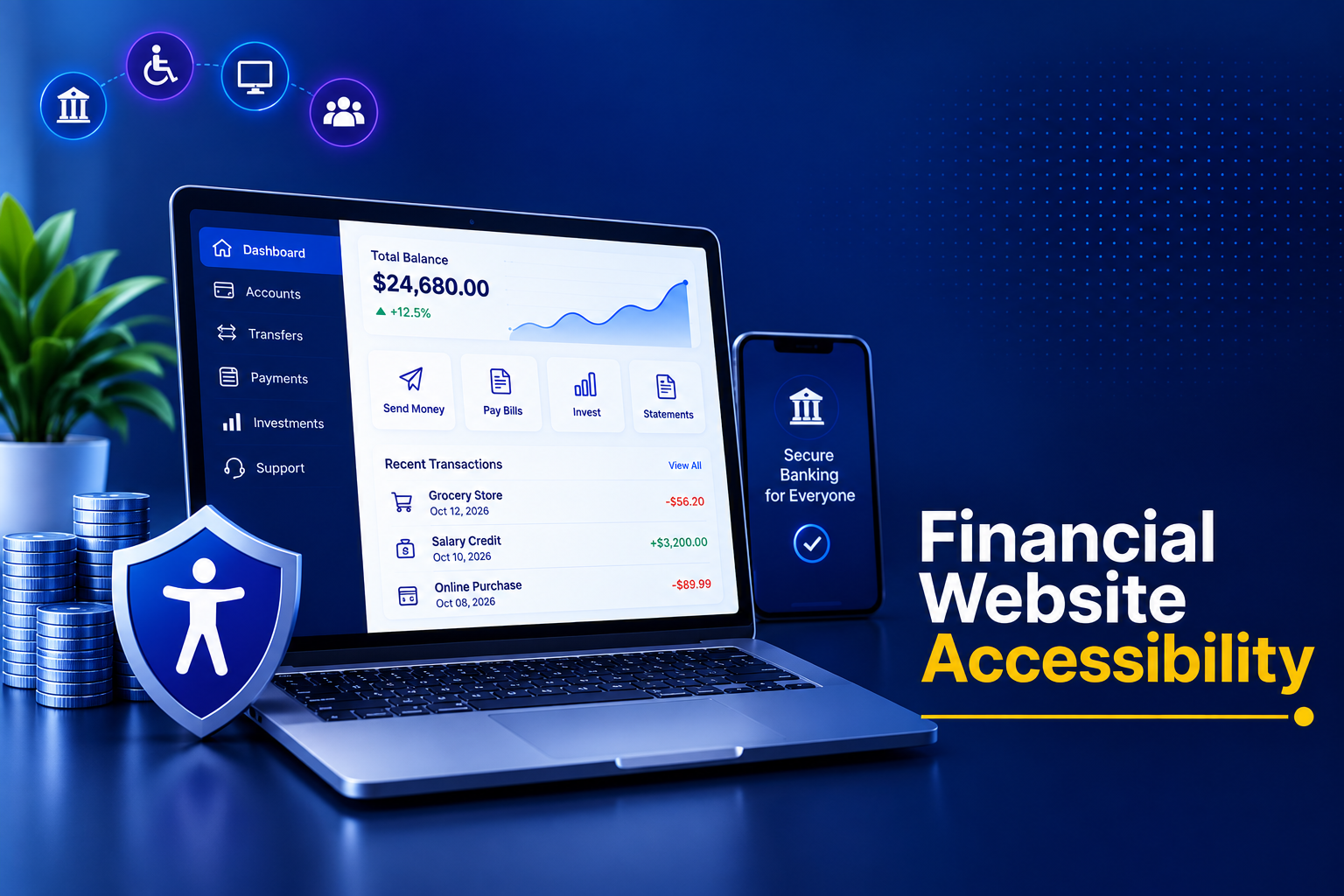
Most financial decisions are impulsive, and software with a bad interface and unreliable service often gets rejected by its users. Therefore, all digital services need to provide a seamless user experience to all their users regardless of their disabilities. Refusing to make your digital product accessible in 2026 will inevitably result in severe regulatory action and legal penalties under laws like the Americans with Disabilities Act (ADA) and Section 508.
Financial services leaders overwhelmingly agree that accessibility improves both user experience and business performance. From attracting new customers to strengthening retention, accessibility plays a critical role throughout the customer journey, ultimately contributing to stronger revenue and long-term growth.
In this blog, we will explore how compliance drives conversions and impacts the digital finance service industry.
Table of Contents
The Regulatory Landscape: ADA and Section 508
Financial institutions may be subject to different accessibility regulations depending on the customers they serve and the organizations they work with. Understanding these requirements can help reduce compliance risks and ensure digital services remain accessible to everyone. Let’s delve deeper:
ADA Title II
Impacted institutions: State and local government agencies, including the private FinTechs and vendors that partner with them.
Requirements: Any digital service, such as a digital payment portal, benefits applications, etc., provided by a private company must follow WCAG 2.1 Level AA standards.
Deadline: April 26, 2028 for smaller public entities (Serving towns, cities, etc. with less than 50,000 residents) and April 26, 2027, for larger entities (More than 50,000)
Section 508
Impacted institutions: Federal departments and agencies, including the companies that develop or sell IT products or digital services to them.
Requirements: All digital products and services, such as websites, online training, etc., need to comply with Section 508.
How Accessibility Drives UX, Compliance, and Conversions?
To meet the requirements of both the ADA and Section 508, organizations should follow the Web Content Accessibility Guidelines (WCAG), the internationally recognized standard for digital accessibility. As of late 2025, WCAG 2.2 was officially formalized as an international standard (ISO/IEC 40500:2025). This update brought in crucial new success criteria specifically targeting cognitive and learning disabilities, low vision, and touch-screen accessibility.
For a modern financial strategist, aligning with WCAG 2.2 Level AA is simply the safest, smartest way to protect the brand and serve your whole audience. Now let us understand how accessibility impacts your organization:
Eliminating Friction in the Funnel
Financial marketing leans heavily on complex conversion funnels: think multi-step credit card applications or dense retirement calculators. If those forms have terrible color contrast, lack descriptive labels, or aggressively time out, users will abandon them.
Look at the new WCAG 2.2 criterion 3.3.8 (Accessible Authentication). It clearly states that users shouldn’t have to pass a cognitive test, such as memorizing a complex password or solving a visual puzzle just to log in. By implementing passwordless logins or biometric authentication, you don’t just satisfy a compliance standard. You radically streamline the login process, shooting user retention and conversion rates through the roof.
Expanding Market Reach
The global community of people with disabilities controls trillions of dollars in disposable income. When your ad campaigns point to an inaccessible landing page, you are actively rejecting their capital. Inclusive marketing flips the script. By ensuring your video ads have synchronized closed captions and your email campaigns use semantic HTML for screen readers, you build deep brand loyalty with a high-value, historically underserved demographic.
The SEO Synergy
Accessible code is incredibly good for SEO. Search engine crawlers navigate the web a lot like screen readers do. When you structure a financial blog with proper heading tags (H1, H2, H3), write descriptive alt text for your infographics, and build a logical site architecture, you make the content easily digestible for both assistive tech and Google’s ranking algorithms.
Real-World Breakdowns: Portals, Forms, and Dashboards
To see the practical impact of WCAG guidelines, let’s look at exactly where financial services usually fail and how to fix those failures.
The Stock Market Trading Dashboard
Consider an active retail investor tracking international stock exchanges on an advanced trading dashboard. They rely heavily on technical indicators, utilizing moving average lines overlaid on a price chart to make split-second decisions.
The Barrier: If the dashboard relies exclusively on color to convey this data, say, a green line for the moving average and a red line for price action, a user with color vision deficiencies literally cannot see the trend.
The Solution: To achieve compliance, the dashboard has to use secondary indicators alongside color. You make the moving average a dotted line and the price action a solid line, while also providing a readable, structurally tagged data table right below the chart. This ensures the data is perceivable for everyone, allowing them to trade independently.
The Multi-Step Mortgage Application
Loan originators need lengthy digital forms to gather sensitive financial data.
The Barrier: A user with a motor impairment relies entirely on a keyboard to browse the web. If your mortgage app has a “keyboard trap” where they tab into a dropdown menu but can’t tab back out, they are completely locked out of the application. Add to that a lack of clear error text (like outlining a missed field in red instead of explicitly stating “Error: Annual Income Required”), and visually impaired applicants won’t be able to submit their information either.
The Solution: Developers have to build proper focus indicators so keyboard users always know exactly where they are on the page. Forms need clear ARIA (Accessible Rich Internet Applications) labels and descriptive text errors, guaranteeing that anyone can successfully submit their data.
Improve Financial Website Accessibility
Many financial websites run into the same accessibility issues across key customer journeys. Account opening forms often have unclear labels, confusing error messages, inaccessible CAPTCHAs, or sessions that expire without warning. Loan applications may lack progress indicators, hide field labels, or make keyboard navigation difficult. These issues can lead to abandoned applications, lower conversions, and frustrated customers.
Financial institutions can improve accessibility without rebuilding their websites from scratch. Start with regular testing, user feedback, WCAG guidelines, clear navigation, plain language, and accessible customer support.
Accessible banking creates easier, safer experiences while helping institutions:
- Reach more customers
- Reduce compliance risks
- Build trust and loyalty
- Strengthen their reputation
- Gain a competitive advantage
Accessibility benefits both customers and financial institutions by making digital banking more inclusive, independent, and user-friendly.
Wrapping Up
Digital accessibility and usability complement each other, as their common goal is to ensure users don’t face any barriers or difficulties when they use the product or service.
Following WCAG 2.2 Level AA helps make websites, apps, forms, and digital services easier to use for everyone while improving SEO, expanding market reach, and building customer trust. Although violating the accessibility laws will cause regulatory fines, civil lawsuits, etc., you also lose out on revenue as you are voluntarily excluding a certain percentage of the population from using your service.
When you are on the verge of making your digital offering accessible, focus on the right path and avoid using shortcuts like accessibility overlays. People who make impulsive financial decisions are already in difficult situations, so don’t make it harder for them by avoiding accessibility.
By taking practical steps such as regular accessibility testing, clear navigation, and accessible forms, financial organizations can create more inclusive experiences that benefit both customers and the business. Reach out to us at AEL Data today to assist you.