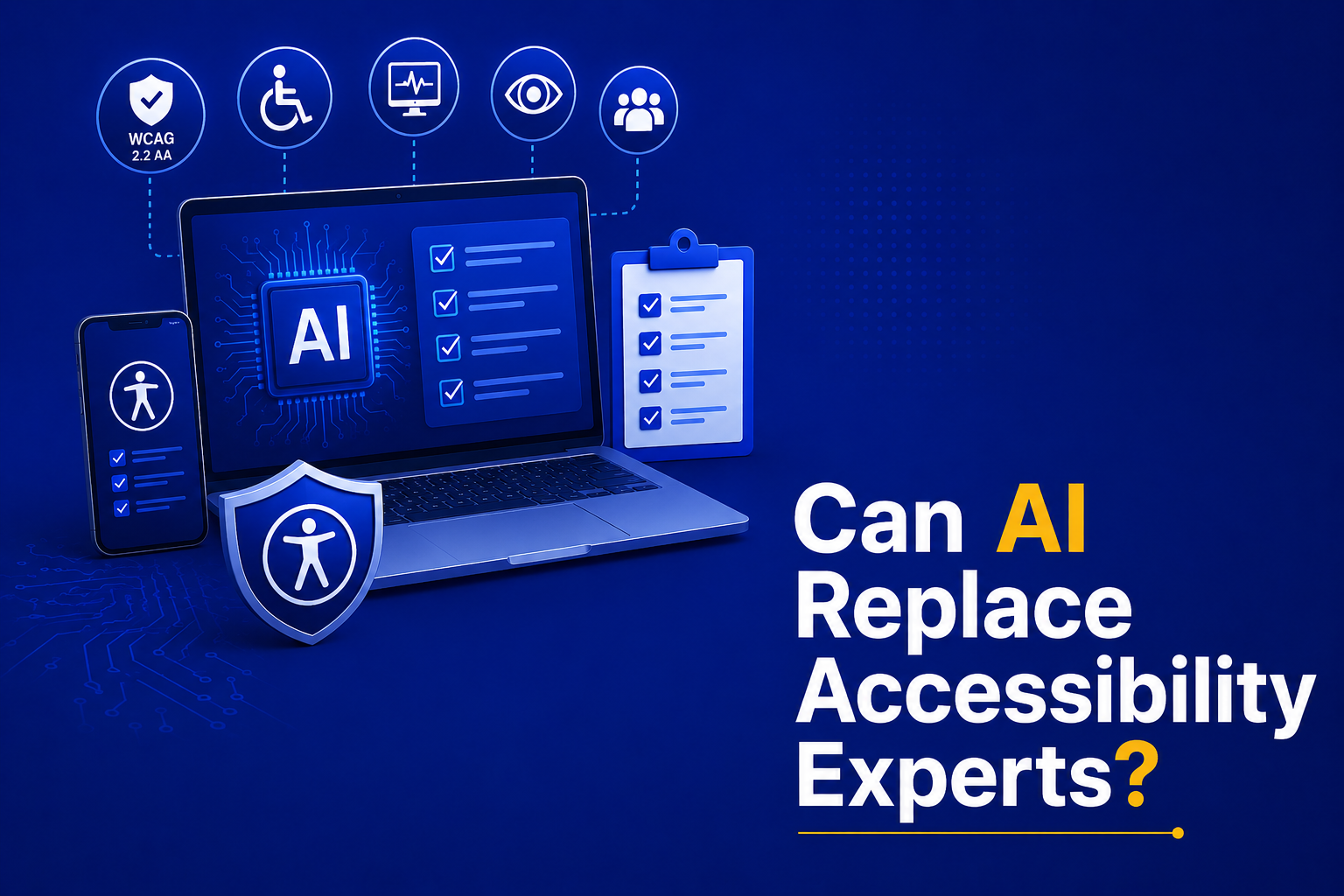
Every day there are stories of how AI is evolving, and there is a growing uncertainty about human involvement. But is it true? The demand for inclusion from customers and the escalating number of lawsuits are putting a growing amount of pressure on businesses to improve the accessibility of their websites. Accessibility technologies (which are mostly self-driven) are used by many for fast, affordable solutions. These tools can make accessibility easier to build and scale, but they also come with risks.
Human accessibility specialists cannot be replaced by these tools. While the latter can help, it cannot guarantee accessibility. This blog discusses AI’s shortcomings in accessibility testing and recommends a hybrid method that blends AI with human experience for the best results.
Table of Contents
Advantages Of AI
AI tools have improved significantly in recent years. They offer several benefits when used correctly. It is becoming an important part of accessibility work. It can scan content quickly, catch common issues, and monitor websites continuously, making it easier to identify problems early. Read more:
1. Speed and Scale
AI scans thousands of pages in minutes. A manual audit of a large website can take weeks, but AI delivers initial results almost instantly, giving you a broad view of potential issues across your entire digital presence.
2. Detecting Technical Violations
Automated tools excel at identifying technical failures. They catch missing alt text, empty headings, insufficient color contrast, and missing form labels. These are objective checks that algorithms handle efficiently.
3. Monitoring Constantly
AI tools can keep an eye on your site for as long as you use them. Accessibility problems are found automatically every time you post new content or code changes, so they do not make it to production.
4. Judicious Screening
AI technologies are a good way for small firms with tight resources to get started. They help you find easy wins and give you a basic idea of how accessible your site is.
These strengths make AI a valuable asset. But they also create a dangerous illusion—that accessibility is purely a technical problem solvable by software. It is not.
These capabilities save time and make accessibility more approachable, especially for teams with limited resources. But while AI is a powerful tool, accessibility is about more than technical fixes, and that’s where human expertise still matters.
AI’s Limitations
No amount of tweaking algorithms can get around AI’s basic problems. Any firm that cares about accessibility needs to know about these gaps. AI is a powerful accessibility tool and can identify many technical issues, but it cannot understand people, context, or real-world usability.
Here are some key areas where human expertise remains essential.
1. Cannot Understand Context
Consider an image on your website. An AI tool can detect that the image lacks alt text. It can even generate alt text using computer vision. Can it detect if alt text is meaningful?
Mark images that are just ornamental. Images may communicate complicated information that requires careful explanation. Sometimes alt text must alter depending on context or user intent. AI cannot make these judgments contextually.
2. It Cannot Evaluate True Usability
Accessibility is not about passing automated checks. It is about whether a real person with a disability can complete a task on your website.
Can a blind user navigate your checkout flow using a screen reader? Can someone with limited mobility operate your carousel using only a keyboard? Can a user with cognitive disabilities understand your form instructions?
AI cannot answer these questions. Only human testing, with real assistive technology and real users, can reveal whether your website actually works for people with disabilities.
3. AI Cannot Assess Logical Reading Order
Automated tools can verify that a page contains headings. But they cannot tell if such headlines make sense when read aloud by a screen reader.
For instance, an AI tool may go through a page where the heading levels go from H1 to H3 without going through H2. There is no problem because the code technically has headers. But for a screen reader user, the navigation structure becomes confusing and disorienting. Only a human expert can evaluate whether the heading hierarchy creates a coherent experience.
4. It Cannot Interpret Complex Interactions
Modern websites include dynamic content, modals, drag-and-drop interfaces, single-page applications, and custom widgets. AI struggles to test these interactions thoroughly.
Does the modal trap keyboard focus correctly? Does the drag-and-drop interface provide accessible instructions and feedback? Does the live region announce dynamic content updates appropriately? These scenarios require manual testing by experts who understand assistive technology behavior.
5. Is Not Capable Of Addressing the Human Element of Accessibility
Accessibility involves more than code. It needs commitment from the organization, training, and procedures. You cannot use an automated tool to make an accessibility program, educate your developers, or write rules for making content that is accessible. It cannot check a PDF file for accessibility or see whether the subtitles on your movie are correct and in sync.
6. AI doesn’t have empathy
Accessibility is about more than meeting guidelines. It’s about creating experiences that work for real people. AI can flag issues like an incorrect heading structure, but it can’t understand how those issues affect someone using a screen reader, navigating with a keyboard, or relying on clear language. That kind of empathy and user-centered thinking is what makes human accessibility experts indispensable.
AI is great at quickly finding common accessibility issues and handling repetitive tasks, but it lacks context, judgment, and empathy. While it can spot obvious errors, it can’t understand real user needs or make nuanced accessibility decisions. Think of it as an advanced spell-checker: useful for catching mistakes, but not a replacement for human expertise.
Real-World Limitations of Relying Only on AI
Many times firms buy an automated accessibility tool, conduct a scan, repair the problems that come up, and then proudly say that their website is accessible. Months later, they face a lawsuit or receive angry feedback from users who cannot use their site.
Why does this occur?
The Overclaim Problem
Some AI-powered accessibility vendors make bold claims. They promise full compliance with a single line of code. They offer widgets that claim to “fix” accessibility issues automatically. These claims mislead businesses into believing accessibility is a one-time technical fix.
The reality is different. Purely automated methods and overlay tools can cause more issues than they resolve. They can conceal underlying problems, conflict with assistive technology, and give people a false feeling of security.
The False Compliance Trap…
Most automated tools only assess 20-30% of the success criteria in the Web Content Accessibility Guidelines (WCAG). The remaining 70 percent require human judgment. When businesses rely only on automated scans, they believe they are compliant when they have actually addressed only a fraction of the requirements.
The User Experience Gap
I have watched screen reader users attempt to navigate websites that passed every automated test with flying colors. The experience was painful. Buttons lacked proper labels. Focus indicators disappeared. Forms became impossible to complete. The automated tools gave a passing grade, but real users could not accomplish basic tasks.
This gap between automated scores and real-world usability is where businesses get into trouble.
The Role of Manual Audits and Usability Testing
Automated scans are a great starting point, but they can’t tell you how accessible your website really is. That’s where human testing comes in. If AI cannot do the job alone, what does a complete accessibility program look like? It combines automated testing with human expertise.
Manual Audits
A manual audit involves accessibility experts reviewing your website page by page, interaction by interaction. They evaluate:
Whether keyboard navigation follows a logical flow
Whether screen reader announcements are clear and meaningful
Whether color contrast works across all states (hover, focus, active)
Whether error messages are helpful and accessible
Whether focus management handles dynamic content correctly
Manual audits catch what automated tools miss. Experts apply WCAG guidelines with nuance, considering context, user intent, catching issues that automated tools often miss, and real-world scenarios.
Usability Testing with People with Disabilities
Even the best manual audit benefits from usability testing. Watching actual users with disabilities interact with your website reveals insights no checklist can provide.
A user might struggle with a form that technically meets all WCAG criteria but presents cognitive overload. A screen reader user might find workarounds for poor markup, but the effort required reveals friction points. These observations lead to meaningful improvements that go beyond compliance.
Assistive Technology Testing
Accessibility doesn’t stop at automated checks. To understand how people actually experience your website, experts test it using a range of assistive technologies. Experts test your website across multiple assistive technologies:
- Screen readers (JAWS, NVDA, VoiceOver, TalkBack)
- Screen magnifiers
- Speech recognition software (Dragon NaturallySpeaking)
- Keyboard-only navigation
- Alternative input devices
Each technology behaves differently. Testing across them ensures compatibility for the widest possible audience.
Why Does the Hybrid Approach Works Best?
The best accessibility results come from combining AI with human expertise. AI takes care of repetitive tasks and quickly flags common issues, while experts focus on the complex decisions that require context, testing, and judgment. AI and human experts are not competitors. They are partners.
AI Handles the Repetitive Work
AI excels at scanning large sites, monitoring for regressions, and catching technical violations. It provides a safety net that catches common errors quickly.
Experts Handle the Complex Work
Human experts interpret context, evaluate usability, test with assistive technology, and make judgment calls that AI cannot. They provide strategic guidance, train your team, and ensure your accessibility program matures over time.
Together, They Create Sustainable Accessibility
A hybrid approach gives you the speed of automation and the depth of human expertise. You catch issues early with AI, then rely on experts to validate, refine, and address the nuances.
This combination also builds internal capability. Experts train your developers and content creators, reducing the number of issues AI needs to catch in the future.
AI supports designers, developers, researchers, and accessibility experts, but it doesn’t replace their expertise. Instead, it frees them to focus on the work that requires human judgment.
Over time, accessibility becomes embedded in your workflow rather than an afterthought.
How AEL Data Bridges the Gap!
At AEL Data, we combine AI-powered automation with deep human expertise. We use AI to handle repetitive scans and catch technical issues fast. Then our accessibility experts step in to do what AI cannot—manual audits, assistive technology testing, and strategic guidance.
- We help businesses build sustainable accessibility programs through:
- Hybrid audits that blend automation with expert review
- Real-world testing with screen readers and assistive technologies
- Ongoing support and team training
With years of experience serving enterprises and organizations worldwide, AEL Data delivers accessibility you can trust—because true inclusion requires more than software.
Conclusion
AI has changed the way we approach accessibility, and that’s a good thing. It helps teams work faster, catch common issues early, and monitor websites at scale. But accessibility is ultimately about people, not just code. It requires context, judgment, empathy, and real-world understanding that human expertise provides.
Businesses that rely solely on AI expose themselves to legal risk and user frustration. The smarter path combines automation with expert-led testing, manual audits, and ongoing support. AI won’t replace accessibility experts. It is one of the most exciting advances in accessibility, with the potential to make inclusive experiences easier to build and scale. But it works best when it’s used to support people, not replace them.
Ready to move beyond automated shortcuts? AEL Data brings the expertise you need to build truly accessible digital experiences. Let us help you get it right.