Think of building a global website like constructing a building that must open its doors in five different countries. The blueprint for the ramp, the door width, the elevator buttons; the rules for access change at every border. For the digital world, these are accessibility laws, and they form a complex global maze.
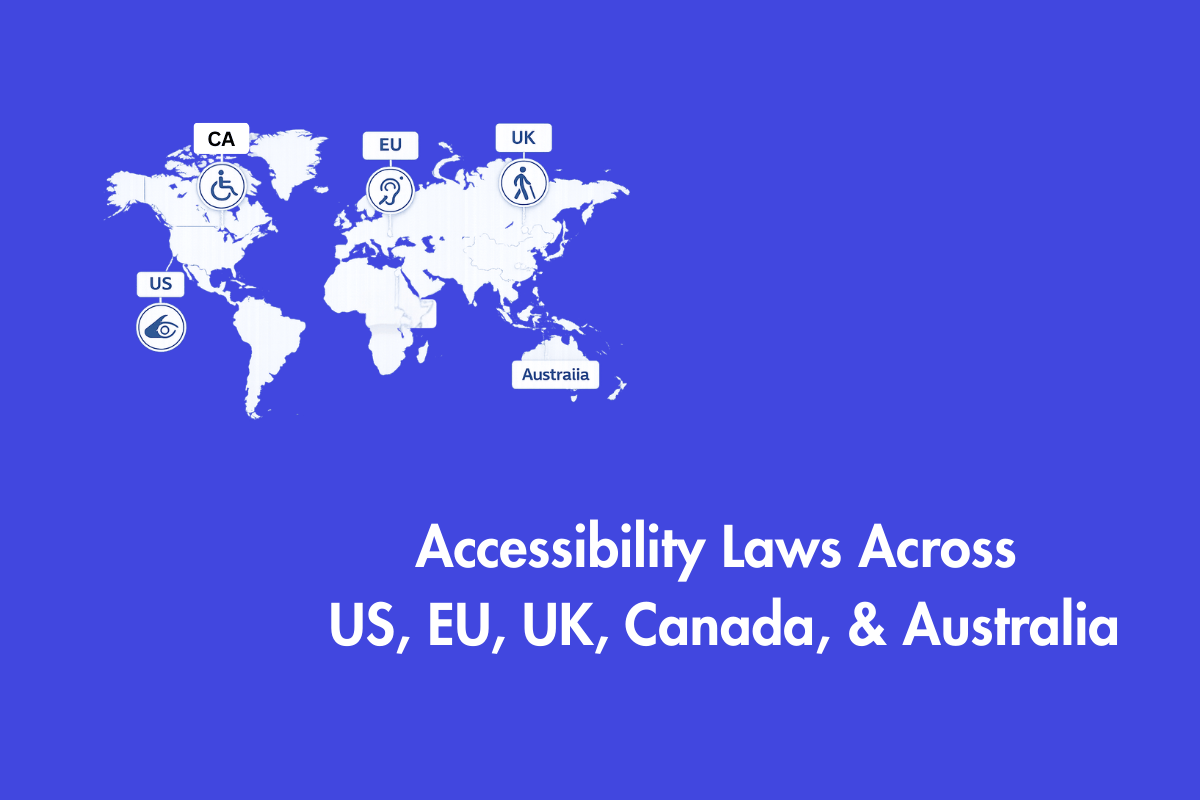
You can’t use one map for all five territories. This is your clear, human guide to the different rules in the US, EU, UK, Canada, and Australia—not as a dry legal list, but as a practical landscape you need to navigate.
First, The Golden Thread: WCAG
No matter where you are, you’ll hear one term over and over: WCAG (the Web Content Accessibility Guidelines). It’s not law itself, but it’s the universal building code. Every region we discuss points to it: usually WCAG 2.1 Level AA, as the technical “how-to.” The difference lies in how each place enforces it.
Some use it as a weapon in lawsuits, others as a checklist for government audits.
Now, let’s walk the map.
1. The United States: The Wild West of Lawsuits
There is no tidy government rulebook. Instead, the U.S. accessibility landscape is powered by its most influential force: private lawsuits.
The Law in Play:
The Americans with Disabilities Act (ADA). It’s a broad civil rights law written before the modern web. Courts have decided it absolutely applies to digital spaces. Section 508 of the Rehabilitation Act of 1973 is another primary law that ensures accessibility for people with disabilities. While ADA applies to all spaces, Section 508 applies to U.S. federal organizations.
How It Really Works?
Imagine a sheriff’s office that’s closed, but every citizen has a legal gun. There’s no federal agency proactively checking websites. Instead, a very active plaintiffs’ bar files thousands of lawsuits annually, demanding WCAG compliance and settlements.
Your Real-World Takeaway:
Compliance here isn’t about pleasing a regulator, it’s about lawsuit prevention. Proactive, documented WCAG conformance isn’t just a best practice, it is your primary legal shield.
2. The European Union: The Architects of Bureaucracy
The EU favors a structured, forward-looking framework, building comprehensive systems rather than merely reacting to individual cases.
The Laws:
Two key pieces work together. The Web Accessibility Directive (WAD) covers all public sector sites (governments, universities). The newer European Accessibility Act (EAA) targets the private sector (e-commerce, banking, apps) with a major 2025 deadline.
How It Really Works?
Think “certification and declaration.” Member states translate these directives into national law. The requirement isn’t just to comply, but often to publish a detailed accessibility statement—a public report card on your conformance.
Your Real-World Takeaway:
This is about systematic compliance and transparency. You need processes, monitoring, and that public statement. It’s less about a surprise lawsuit and more about failing an official audit.
3. The United Kingdom: The Principle-Based Powerhouse
Post-Brexit, the UK stands on its own robust law: beautifully simple and terrifyingly broad.
The Law:
The Equality Act 2010. It doesn’t mention websites or WCAG. It simply states it’s illegal to discriminate against people with disabilities when providing a service.
How It Really Works?
This principle-based approach means everything digital is in scope:every app, every website, every intranet for a UK-based company. The government’s own guidance points to WCAG as a way to avoid discrimination make it the de facto standard.
Your Real-World Takeaway:
There are no checkboxes to hide behind. The question is simple: Can a person with a disability use your service as effectively as anyone else? If not, you’re in violation of a very powerful law.
4. Canada: Ontario’s Shadow is Long
Canada has two layers, and one province looms so large that it defines the conversation.
The Laws:
The Accessible Canada Act (ACA) covers federal organizations including banks and telecoms. But the real heavyweight is Ontario’s Accessibility for Ontarians with Disabilities Act (AODA).
How It Really Works:
The AODA is specific, phased, and mandates proactive compliance reporting. If you have 50+ employees in Ontario, you must file reports detailing your accessibility. It has teeth with the potential for administrative fines.
Your Real-World Takeaway:
For any organization in or serving Ontario, this is non-negotiable homework. It’s not only just about being accessible but also about proving to the government (on their schedule!).
5. Australia: The Complaints-Driven Mirror
Australia borrows from both the U.S. and UK, carrying a distinctly Australian style that is relaxed right up to the point where it’s not.
The Law:
The Disability Discrimination Act (DDA). Like the UK’s law, it’s broad and principle-based and prohibits discrimination in services.
How It Really Works:
Enforcement typically starts with a complaint to the Australian Human Rights Commission. The focus is on resolution and conciliation. However, if that fails, cases can go to federal court, creating serious precedent (and hefty fees).
Your Real-World Takeaway:
The system encourages fixing issues when they’re raised, but ignoring a complaint is a high-stakes gamble. The safest path is proactive compliance to avoid a damaging legal process.
In other parts of the world…
Accessibility laws worldwide aim for the same destination but travel very different roads. India and China lean on broad rights laws backed by WCAG standards, Japan nudges rather than mandates, and France and Italy enforce hard rules with real penalties. Dubai pairs disability rights with mandatory digital access, while Spain is preparing to fully switch on EU-backed enforcement by 2025. Different styles, one clear message: accessibility is no longer optional.
Navigating Your Path: The Human Strategy
Global accessibility laws can feel like five rulebooks in different languages. One misstep risks fines, lawsuits, or leaving users behind. The goal is simple: a digital world that works for everyone, everywhere. Here’s the human strategy:
Build Right, Build Once:
Design and develop everything to WCAG 2.1 AA from the start. This is your universal passport.
Know Your True North:
Identify your core risk. Is it the lawsuit frenzy of the US? The regulatory reporting of Ontario and the EU? Or the broad non-discrimination principles of the UK and Australia? Your primary geography dictates your urgency and process.
Speak the Local Language:
In the EU, draft an accessibility statement. In Ontario, calendar your reporting deadlines. In the US, document your compliance efforts for legal defense.
The goal isn’t just to check boxes across five countries. It’s to build a digital world that is genuinely open for business; for everyone, everywhere. That’s the only map worth following.
Contact us at AEL Data today to understand better.