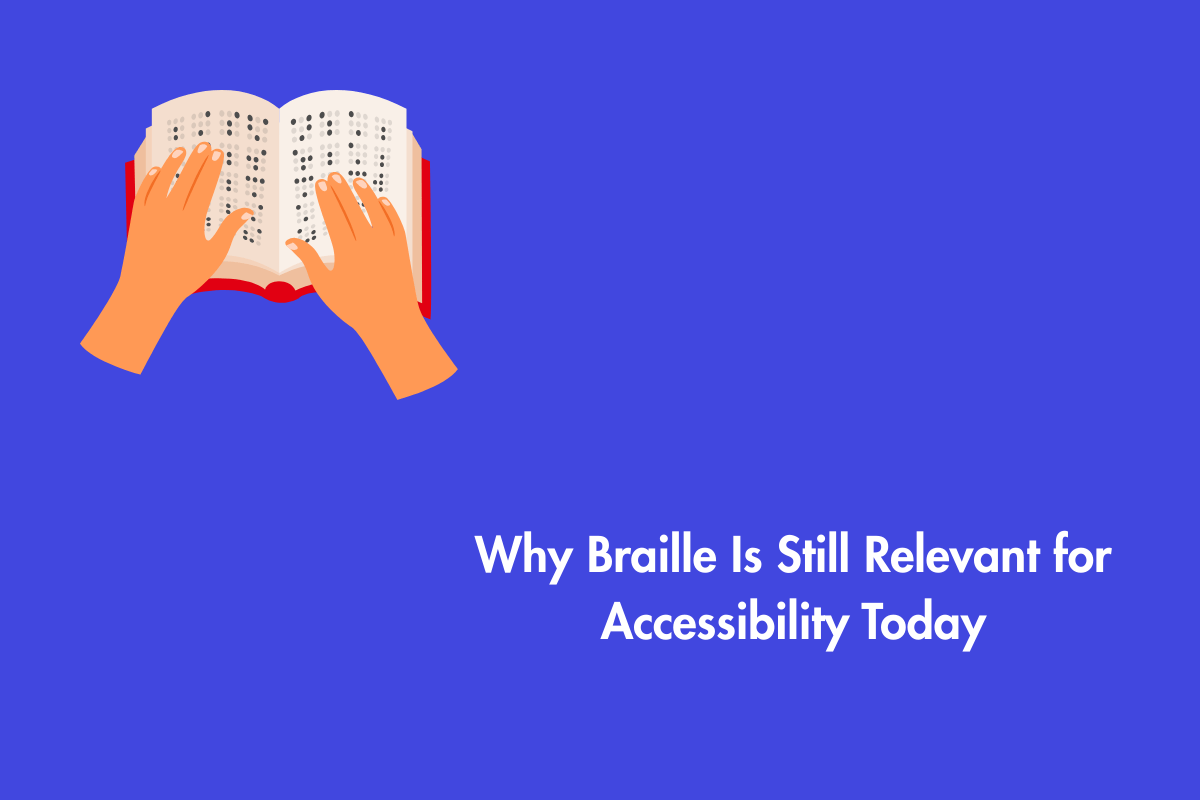
World Braille Day is observed every year on January 4th, and it’s a moment to appreciate how important Braille is for people who are blind or partially sighted. The day was first celebrated in 2019 and it honors the birth of Louis Braille, who created the tactile reading and writing system that changed accessibility forever. It’s also a reminder that access to information and communication should be available to everyone.
The nineteenth-century Braille system, formerly thought obsolete by audiobooks and voice assistants, is essential for deep literacy, independence, and intellectual freedom. Braille has always been more than a pattern of dots. It is a language of touch that makes reading and writing possible in almost any language.
Over time, it has grown to include music, math, science, computing, and more, showing how adaptable and relevant it remains. Braille is a living, evolving language that works beautifully with modern technology, and it continues to open new doors for people who are blind or visually impaired. This post discusses Braille’s digital progression, cognitive benefits and how it empowers millions with the timeless power of the written word to create an inclusive future.
Table of Contents
- 1 The Digital Evolution – Braille in the 21st Century
- 2 Braille E-Readers and Mainstream Integration
- 3 The Literacy Advantage: Beyond Listening
- 4 Cognitive Depth and Mastery
- 5 Braille vs. Audio: A Clear-Cut Comparison
- 6 The Pitfalls of “Audio-Only”
- 7 A Tool for Autonomy & Independence
- 8 The Future of Braille: Challenges and Innovations
- 9 A Promising Path Forward
- 10 Conclusion: An Enduring Legacy of Empowerment
The Digital Evolution – Braille in the 21st Century
The most compelling refutation to the idea of Braille being outdated, is its remarkable adaptation to the digital age. Far from being left behind, Braille has fused with cutting-edge technology, creating powerful tools that bridge the tactile and digital worlds.
Technology like audiobooks and home computers hasn’t only changed how sighted people read and write. It has transformed things for Braille users too. Refreshable Braille displays connect to computers and phones and allow readers to go paperless. They also work for writing, letting users type in Braille and see their words on the screen. Some even connect to voice assistants like Alexa.
Devices like the Orbit Reader work like a Kindle. They store books on a memory card and present them in refreshable Braille, giving readers a portable library.
Braille Displays That Can Be Updated
Think of these as the Braille equivalent of a tablet or e-reader. These portable devices connect via Bluetooth to your smartphone, computer, or tablet, and feature a row of cells that use tiny, rounded pins that move up and down to form Braille characters in real-time . As you move through a digital document, email, or website, the line of text refreshes beneath your fingertips. This technology gives you direct, private access to digital information without relying solely on audio output. It allows for silent reading in a meeting, confidential review of sensitive documents, and a truly integrated digital experience. Advances in tactile feedback mechanisms have made these displays more compact and affordable, significantly enhancing their reach and accessibility, which helps more people use them.
Braille E-Readers and Mainstream Integration
Similar to popular e-readers, Braille e-readers allow users to store and access vast libraries of books in Braille format . This solves a major logistical problem: traditional Braille books are incredibly bulky, often filling multiple volumes for a single title. Electronic readers are revolutionizing the way individuals access books and reference materials since they can store thousands of volumes. In addition, development of Braille support into software applications has begun at several major IT organizations.
Screen readers that support Braille inputs and outputs are included into products such as Google’s VoiceOver and Apple’s TalkBack, making it easier for those with visual impairments to interact with their devices. Instead of remaining as a niche feature, this mainstream integration is a big step towards democratizing technology and ensuring that persons with visual impairments have access to the same commonly used tools and programs as everyone else.
The Literacy Advantage: Beyond Listening
A common myth is that audiobooks and screen readers can fully substitute for reading. Audio is incredibly helpful, but it’s still a way of consuming information, not truly reading. Braille offers fundamental advantages that audio cannot replicate.
People access the written word in different ways. Braille might not work for someone who has both vision loss and limited hand mobility, so audiobooks could be a better choice. But for someone who is deafblind, audio or magnified text may not help at all, and Braille becomes the best option. No single method can meet everyone’s needs. We rely on a mix of tools, both traditional and modern, to make sure everyone can access reading in a way that works for them.
Cognitive Depth and Mastery
The process of reading Braille is stimulating and busy for the brain. In contrast to hearing, it entails deciphering symbols, creating words, and internalizing punctuation, syntax, and spelling. In complicated areas like physics, arithmetic, and computer programming, where spelling and grammar are crucial, this active participation creates a stronger cognitive foundation. Anexpert from the European Blind Union clarifies a common misconception, noting that “Braille is not a language itself, but it allows visually impaired individuals to access information in a more natural way, similar to reading in one’s own language” . This direct access to the structure of written language is fundamental to true literacy.
Braille vs. Audio: A Clear-Cut Comparison
Listening is not the same as reading. Audio can’t show spelling, punctuation, apostrophes, or how sentences fit together. For people who can use it comfortably, Braille is one of the best ways to learn grammar and sentence structure. It supports stronger reading and writing skills than audio alone.
Further, think of these:
- For Control: Braille lets you set the pace, skim, and re-read. Audio moves in a straight line, dictated by a recording.
- For Complex Work: Braille is essential for technical fields like coding and math. Audio struggles with complex notation.
In short, Braille is active literacy, while audio is passive consumption. Both are valuable, but they are not equal tools for building knowledge and independence.
The Pitfalls of “Audio-Only”
A passive connection with text may result from relying only on auditory. It is challenging to “skim” an audiobook in order to locate a certain section or to swiftly go over a prior paragraph. This lack of navigational control is a major drawback for a professional analyzing a contract or a student preparing for an exam. Additionally, an audio-only method may result in gaps in knowledge of the fundamentals of written language, including paragraph organization and spelling. Braille literacy provides the scaffolding for advanced education and intellectual growth, laying a foundation that listening alone cannot build .
A Tool for Autonomy & Independence
We often think that Braille can only be used for books, but its role in daily life is much bigger than that. Braille quietly supports independence from the moment someone starts their day. It helps label the world around them, guide them through public spaces, and give them control at school or at work. When you look at how it actually shows up in real life, you start to see Braille not as a special tool, but as a practical way for someone to move through the world with confidence and capability.
Let’s delve deeper:
Navigating the Physical and Professional World
From the moment a Braille user wakes up, they interact with a labeled world. They can do more than just play card games with Braille decks. They can also name food in the kitchen, read prescriptions as well as organize files. Braille signs on restroom doors, room numbers, and elevator buttons are important for those who want to be able to find their way about on their own in public places. Braille is a powerful tool for making the workplace more egalitarian. It enables a professional to study reports, take private notes in meetings, and manage their workflow alone. This autonomy is transformative.
Lars Bosselmann, Executive Director of the European Blind Union, points out that creating an inclusive society requires practical steps, including “making physical environments like public transport and buildings accessible”. Braille is the foundation to Physical Accessibility.
Confidence and Self-Esteem Factor
The ability to read and write for oneself is intrinsically linked to self-confidence and personal agency. When an individual can read a restaurant menu, review their own bank statement, or study a textbook without intermediary help, it fosters a profound sense of self-reliance. This counters what one blind advocate describes as “learned helplessness,” where individuals can shift responsibility for accessibility challenges away from themselves . Braille flips this script, putting the power of information directly into the hands of the user. It transforms a person from a passive consumer of information relayed by others into an active, independent participant in their own life.
Fostering Social Inclusion and Equality
Braille is not just a personal tool; it is a public statement about inclusion and the right to access information. Its presence or absence, in our shared spaces sends a clear message about who belongs.
Braille makes a difference in many practical and meaningful ways. It gives people a fully active way to read and write when print is not accessible. It opens the door to games, hobbies, and shared activities with friends and family. It makes it possible to keep notes, create lists, and read personal messages without relying on others. Banks, businesses, and restaurants can provide information and menus in Braille, offering privacy and choice. Books, magazines, and digital tools expand this even further. Whether created by hand, printed with an embosser, or read through a refreshable display, Braille continues to meet people wherever they are, giving them direct access to information in the way that works best for them.
The Right to Access Information
The United Nations Convention on the Rights of Persons with Disabilities, adopted in 2006, explicitly recognizes Braille as a crucial tool for education, freedom of expression, and social inclusion. The COVID-19 pandemic starkly highlighted this need, as public health information was not always available in accessible formats, putting lives at risk. Braille ensures that visually impaired individuals have the same fundamental access to information as everyone else, a right that is essential for civic participation and personal freedom. It is a matter of equality, allowing people to cast a private vote, read the same books as their peers, and form their own opinions based on first-hand information.
Changing Perceptions and Breaking Stigmas
Society often views blindness through a lens of limitation, focusing on what people cannot do. Braille challenges this narrative by showcasing ability and achievement. When a person uses a Braille display to read a report or a Braille menu to order a meal, it shifts the perception from disability to capability. As Bosselmann wishes, society needs “a shift in focusing on abilities and achievements rather than limitations or disability” . Braille is a powerful catalyst for this shift. It demonstrates that blindness is not a barrier to literacy, education, or professional success, but simply a different way of interacting with the world. By normalizing Braille in public and digital spaces, we help build a society that values diversity and sees the person first.
The Future of Braille: Challenges and Innovations
Braille has already proven its worth, but the journey is far from over. As we look ahead, the challenge is to remove the barriers that still stand in the way and pair Braille with the technologies that are shaping our world. The aim is simple: a future where Braille is easier to learn, easier to access, and seamlessly built into everyday tools, rather than treated as something separate or out of reach.
Overcoming Barriers
The primary obstacle for many is cost. High-end refreshable Braille displays can run into thousands of dollars, placing them out of reach for many individuals and institutions . Additionally, learning Braille as an adult presents its own set of challenges, including the need for neurological adaptation to tactile reading and finding the time and resources for study amidst other adult responsibilities. Awareness that digital accessibility is broader than just screen-reader compatibility is much needed; true accessibility includes Braille support. Addressing these issues requires concerted effort from technology companies to drive down costs and from institutions to provide robust support and training.
A Promising Path Forward
The future is bright with innovation. Organizations and tech companies are continuously investing in research to create more affordable and efficient Braille technology. Furthermore, the potential for Artificial Intelligence (AI) to enhance Braille is immense. AI could be used to automatically generate Braille versions of digital documents and websites from the outset, eliminating the need for manual adjustments. Smartphone apps powered by AI and improved navigation systems are already making mobility easier, and when combined with Braille output, they can offer both auditory and tactile information for a richer experience. The goal is a future where Braille is not a separate, specialized tool, but an integrated, universally available feature of our digital ecosystem.
Conclusion: An Enduring Legacy of Empowerment
Braille is far more than a series of dots on a page. It is a dynamic and vital form of literacy that has successfully transitioned into the digital era. It provides a depth of understanding and a level of cognitive engagement that audio cannot match. It is a practical tool for daily independence and a powerful symbol of social inclusion that asserts the right of every individual to access the written word.
The conversation should never be about Braille or technology. The true power lies in Braille and technology. As we look to the future, our goal should not be to find replacements for Braille, but to build a world where it is more accessible, more integrated, and more widely understood. By supporting the development of affordable Braille technology, advocating for its inclusion in public spaces and digital platforms, and challenging the misconceptions that surround it, we can all play a part in upholding this fundamental tool of empowerment. Braille still matters because literacy matters, independence matters, and equality matters. It remains an indispensable key to unlocking a world of knowledge, opportunity, and freedom.